

What is Squint (Strabismus)?
Squint, also known as strabismus, is a condition in which the two eyes are not properly aligned and point in different directions. One eye may look straight ahead, while the other turns inward, outward, upward, or downward.
Because of this misalignment, the brain receives two different images and may suppress the image from one eye. Over time, this can affect binocular vision, depth perception, and visual development, especially in children.
Squint can be present at birth or develop later in life due to refractive errors, muscle imbalance, neurological causes, or visual stress.
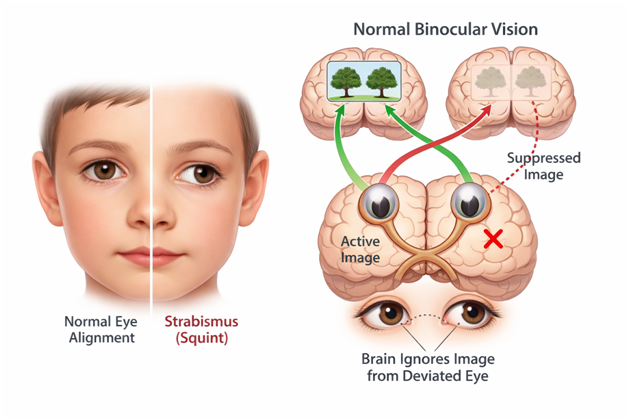
Types of Squint - Based on Direction of Eye Deviation
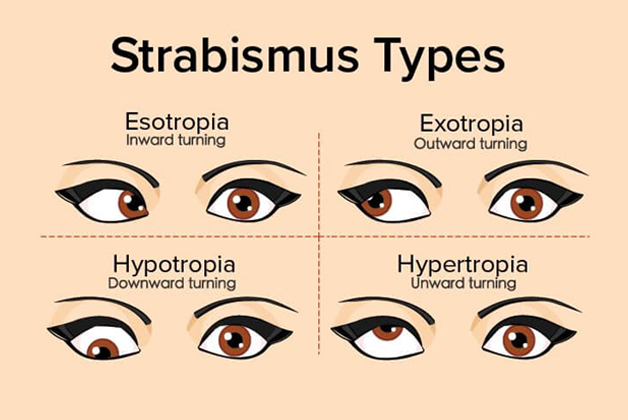
Esotropia (ESO)
The eye turns inward toward the nose.
Exotropia (EXO)
The eye turns outward away from the nose.
Hypertropia (HYPER)
One eye turns upward.
Hypotropia (HYPO)
One eye turns downward.
Based on Control of Deviation
Tropia
A constant and visible eye deviation that is present all the time.
Phoria
A latent or hidden deviation that appears only when the eyes are tired or when binocular vision is disrupted.
How Does Squint Affect Vision?
If left untreated, squint can lead to:
– Amblyopia (lazy eye)
– Poor binocular vision
– Reduced depth perception
– Eye strain and headaches
– Difficulty in reading and concentration
– Psychosocial and cosmetic concerns
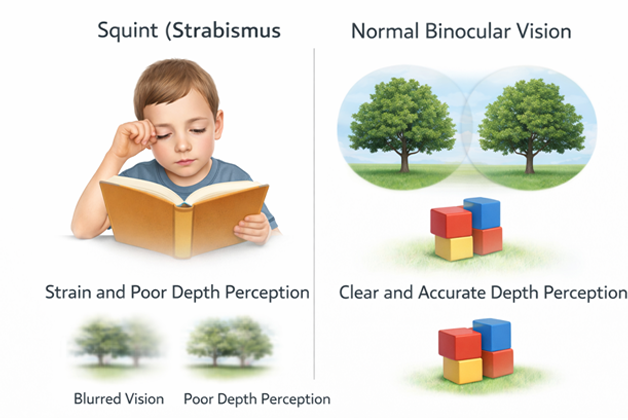
Early detection and intervention play a critical role in preserving normal visual development.
Vision Therapy–Based Treatment Options
Our treatment approach focuses on functional vision improvement, not just cosmetic alignment.
Treatment in Babies and Infants
– Early visual stimulation
– Refractive correction (if required)
– Occlusion therapy when indicated
– Parent-guided visual activities
– Monitoring visual milestones
Early therapy helps guide proper binocular development.
Treatment in Older Children
– Customized vision therapy programs
– Binocular vision training
– Eye teaming and focusing exercises
– Anti-suppression therapy
– Hand–eye coordination activities
– Perceptual and visual processing training
Vision therapy helps the brain and eyes learn to work together effectively.
Treatment in Adults
– Vision therapy for eye coordination and comfort
– Treatment for eye strain, diplopia, and poor depth perception
– Post-surgical vision therapy support
– Occupational and functional vision enhancement
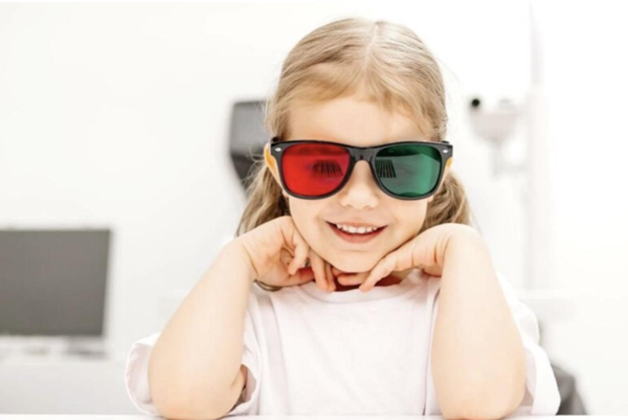
Role of Vision Therapy in Squint Management
Vision therapy is a non-surgical, evidence-based treatment that retrains the visual system. It improves:
– Eye alignment control
– Binocular vision
– Visual comfort and efficiency
– Depth perception
– Visual confidence in daily activities
In some cases, vision therapy is used before or after surgery to achieve optimal and stable results.
Our Approach
– Individualized assessment
– Customized therapy plans
– Child-friendly and adult-focused programs
– Continuous progress monitoring
– Holistic vision rehabilitation
We aim not only to align the eyes but to restore functional vision for life.