
Amblyopia
Amblyopia is an eye condition that affects the ability to see clearly out of both eyes. It usually develops when a child is an infant or very young and can get worse over time if it’s not treated.
If a child has amblyopia, one of their eyes has blurry vision and the other has clear vision. Their brain starts ignoring their blurry eye and only uses the eye with clear vision to see. As their brain relies more on their stronger eye, their weaker eye’s vision becomes even worse over time. Amblyopia is a serious medical issue that needs treatment from an eye care specialist.
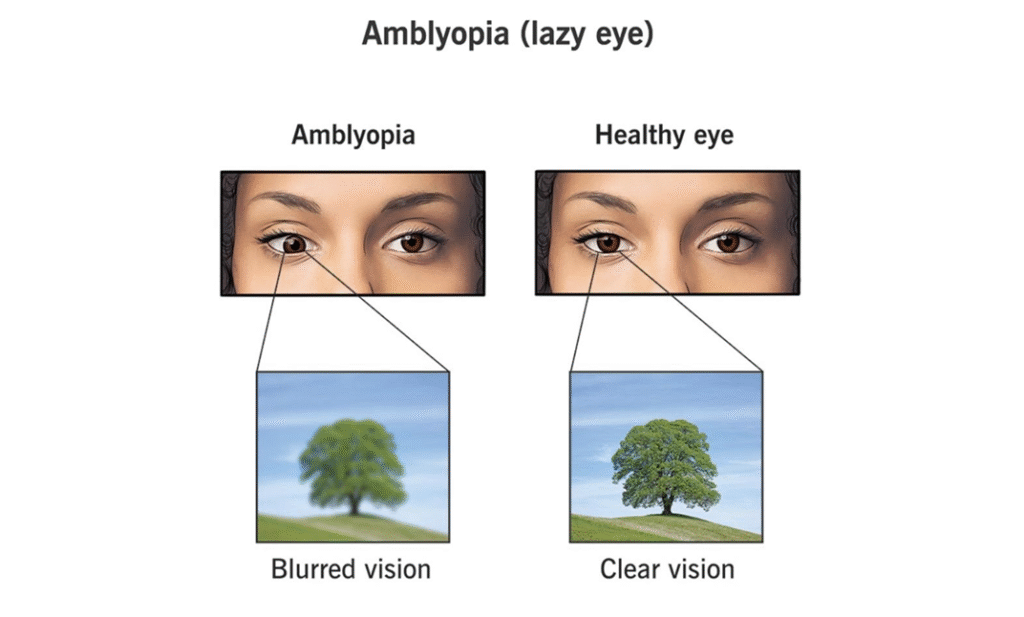
How common is amblyopia?
Amblyopia is the most common reason kids lose their vision. It affects around 5% of children younger than 15.
Symptoms and Causes
What are lazy eye symptoms?
It’s not always easy to tell if your child has amblyopia. Most kids aren’t diagnosed until a healthcare provider or eye care specialist gives them an eye exam.
If you do notice amblyopia symptoms in your child, you’ll probably see changes in how they interact with objects and space around themselves. A child with amblyopia may:
- Bump into objects (especially on one side of their body).
- Favor one side of their body.
- Shut one eye or squint a lot.
- Frequently tilt their head to one side.
- Have crossed eyes.
Have a droopy eyelid.
What causes amblyopia (lazy eye)?
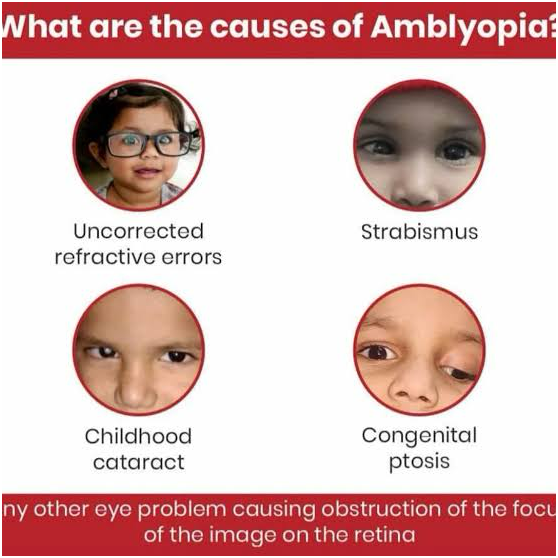
Amblyopia happens when something creates a difference between your child’s eyes and how they focus on the objects they look at. The most common causes of amblyopia are other vision problems, or structural issues with their eyes, including:
Refractive errors
A refractive error is something about the natural shape of your eyes or their ability to focus that makes your vision blurry. If your child has a refractive error that’s not treated right away, they can develop amblyopia. Refractive errors in kids that lead to amblyopia include:
- Nearsightedness (myopia) — trouble seeing far-away objects.
- Farsightedness (hyperopia) — trouble seeing objects that are up close.
- Astigmatism (having an oval-shaped cornea).
Strabismus
Strabismus (crossed eyes) happens when your eyes don’t line up with each other. Your eyes usually move together at the same time. If one of your child’s eyes moves without matching the other, their brain may start relying on one eye over the other.
Structural eye conditions
Any condition that affects how your child’s eyes function can cause blurry vision and lead to amblyopia, including:
- Droopy eyelids (ptosis) — especially if one eyelid droops enough to block some of your child’s eye.
- Cataracts — clouding in the lens of your eye.
- Issues with their cornea (the clear part at the front of your eye).
Amblyopia (lazy eye) risk factors
Any child can develop amblyopia. Some factors make kids more likely to experience amblyopia, including:
- Having biological family members with eye and vision problems.
- Developmental delays.
- Premature birth (being born before 37 weeks of pregnancy).
- Low birth weight (being born weighing less than 5 pounds, 8 ounces or 2,500 grams).
Treatment of Amblyopia
Amblyopia is treatable at any age, although the earlier the problem is found and treated, the more successful the outcomes tend to be. Until recently, patching the better seeing eye was the only proven method of treating amblyopia. Recent research has shown that a binocular approach to treating amblyopia may be an effective alternative to patching. Treatment that relies less on patching may avoid unnecessary emotional stress on a child or their family.
Treatment may include:
- Eyeglasses or contact lenses (proper lenses can help reduce stress so that the under-used eye can start to work more efficiently);
- Patching or penalization of the better-seeing eye;
- Binocular vision activities;
- A program of vision therapy to help improve the visual abilities of the eye with amblyopia including accommodation (focusing), fixation, saccades, pursuits (eye tracking) and spatial skills (eye-hand coordination). A program of vision therapy may reduce the frequency of patching since the goal of amblyopia therapy is to improve eye coordination, improve stereopsis (depth perception) and reduce suppression.