
Special Population Vision Care
Autism Spectrum Disorder (ASD), ADHD & ADD
Children and adults with Autism Spectrum Disorder (ASD), Attention Deficit Hyperactivity Disorder (ADHD), and Attention Deficit Disorder (ADD) often experience visual challenges that go beyond eyesight alone. These challenges can significantly affect behavior, attention, learning, sensory regulation, and emotional responses.
Behavioral optometry focuses on how the visual system works together with the brain and body, helping these individuals function more comfortably and efficiently in daily life.
Visual Challenges in Autism, ADHD & ADD
Many individuals in this special population may experience:
Amblyopia
– Poor eye teaming (binocular vision issues)
– Difficulty with eye tracking and focusing
– Visual hypersensitivity or visual overload
– Reduced visual attention span
– Poor visual processing and integration
– Difficulty with near work such as reading or writing
– Increased visual fatigue leading to irritability or meltdowns
These visual stressors often contribute to restlessness, poor concentration, avoidance behaviors, anxiety, and difficulty calming down.
Role of Behavioral Optometry
Behavioral optometry evaluates how vision impacts behavior, posture, learning, and sensory processing.
Instead of only checking clarity of vision, we assess:
– Eye teaming and coordination
– Visual motor integration
– Visual processing skills
– Visual attention and endurance
– Sensory-visual integration
This approach is especially beneficial for children with neurodevelopmental differences.
How Vision Therapy Helps in Autism, ADHD & ADD
Vision therapy is a customized, non-invasive, brain-based program designed to improve how the visual system functions and integrates with the brain.
Key Benefits of Vision Therapy
– Improves eye coordination and visual comfort
– Reduces visual overload and sensory stress
– Enhances visual attention and focus
– Supports better emotional regulation
– Improves posture and body awareness
– Enhances reading readiness and learning efficiency
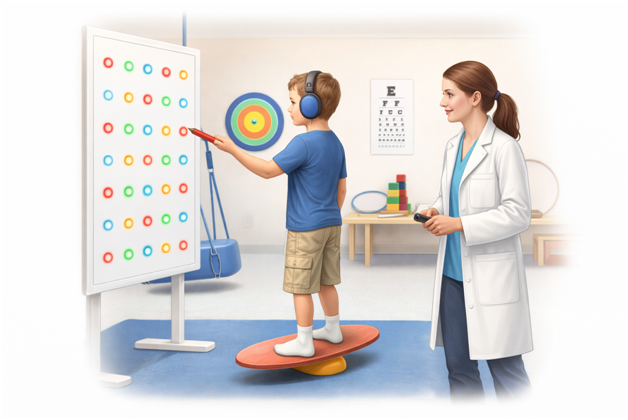
Vision Therapy and Calming the Nervous System
For many children with ASD and ADHD, the visual system is in a constant state of stress. Vision therapy helps by:
– Reducing excessive visual effort
– Improving predictability of visual input
– Enhancing eye–brain communication
– Supporting vestibular and proprioceptive integration
As visual stress reduces, children often show:
– Improved ability to sit and attend
– Reduced hyperactivity
– Better tolerance to visual environments
– Increased calmness and self-regulation
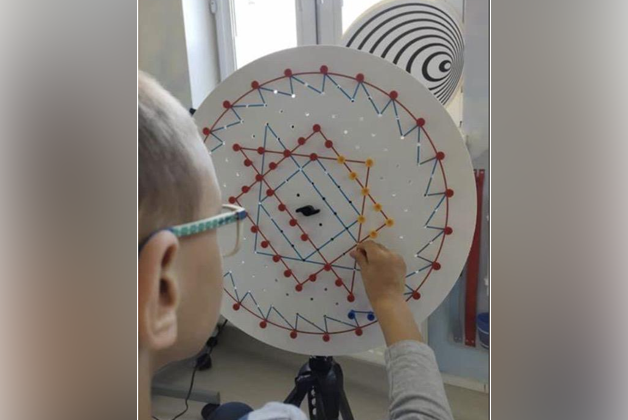
Vision Therapy for Autism Spectrum Disorder (ASD)
Children with autism often experience:
– Visual hypersensitivity
– Poor eye contact
– Difficulty processing visual information
– Avoidance of near tasks
Vision therapy focuses on:
– Gentle visual engagement
– Gradual improvement of eye contact
– Visual-sensory integration
– Structured visual routines
– Improving comfort in visual environments
Therapy sessions are adapted to be child-friendly, predictable, and sensory-sensitive.
Vision Therapy for ADHD & ADD
In children with ADHD and ADD, visual inefficiencies can mimic or worsen attention problems.
Vision therapy helps by:
– Improving sustained visual attention
– Enhancing eye tracking for reading
– Reducing visual fatigue
– Improving classroom performance
– Supporting better task completion
When visual effort is reduced, attention and behavior often improve naturally.
Our Vision Therapy Approach for Special Population
– Individualized functional vision assessment
– Sensory-friendly therapy environment
– Short, structured, and engaging activities
– Gradual progression based on tolerance
– Parent education and home-based support
– Multidisciplinary collaboration when needed
Who Can Benefit?
– Children with autism spectrum disorder
– Children diagnosed with ADHD or ADD
– Children with sensory processing difficulties
– Children with learning or developmental delays
– Adults with attention or visual processing challenges
Our Goal
Our goal is not just to improve vision, but to:
– Enhance quality of life
– Support emotional regulation
– Improve learning and daily functioning
– Help children feel calmer, more confident, and more comfortable in their world